
Reversing Hair Loss: Natural Remedies vs. Clinical Treatments
While natural remedies like batana, castor, and olive oils can improve scalp hydration and reduce hair breakage, they cannot reverse genetic hair loss or reactivate dormant follicles. Regaining lost hair from conditions like pattern baldness requires clinically proven medical or surgical interventions that target the underlying biological causes of thinning.
Key Takeaways
Natural Remedies Provide Only Cosmetic Conditioning: Viral holistic treatments such as batana, castor, and olive oils act as superficial humectants that protect the hair shaft and reduce breakage. They cannot block Dihydrotestosterone (DHT) or reverse the genetic miniaturization of follicles caused by conditions such as Androgenetic Alopecia.
FDA-Approved Interventions Alter Cellular Biology: Over-the-counter serums cannot penetrate the scalp dermis, and supplements (like Biotin) only resolve rare nutritional deficiencies. Arresting genetic pattern baldness requires proven medical interventions like Finasteride (a 5-alpha-reductase inhibitor) or Minoxidil (a powerful vasodilator) to biologically extend the Anagen (growth) phase and protect living follicles.
Surgical Restoration is Required for Dormant Follicles: Once DHT has miniaturized a follicle to the point of complete dormancy and scar tissue has formed, medical management cannot reactivate it. Regaining density in completely bald areas requires advanced surgical techniques (FUE or FUT) performed by expert surgeons, utilizing Donor Dominance to permanently relocate DHT-immune follicles.
Table of Contents
Chapter 1: The Biology of Thinning Hair
Chapter 2: Viral Natural Remedies Fact vs. Fiction
Chapter 3: Over-the-Counter Serums and Supplements
Chapter 4: Clinical and Medical Interventions
Chapter 5: Designing a Long-Term Strategy
FAQs
Chapter 1: The Biology of Thinning Hair
Why Does Hair Fall Out? Understanding the Root Causes
Before evaluating any treatment, whether a holistic oil or a pharmaceutical intervention, it is critical to understand the biological mechanisms of the human scalp. The scalp initially contains roughly 100,000 hair follicles, each operating on an independent, continuous cycle of growth, transition, and rest. When this precise biological rhythm is disrupted, hair loss may occur.
To grasp why certain treatments fail while others succeed, you must first understand the four phases of the hair growth cycle:
The Anagen Phase (Growth): This is the active growth phase of the hair follicle. The cells in the root divide rapidly, adding to the hair shaft. In a healthy scalp, 85% to 90% of hair is in this phase, which lasts anywhere from two to seven years. The length of your anagen phase determines the maximum length your hair can grow.
The Catagen Phase (Transition): Lasting roughly two to three weeks, this is a transitional stage where growth stops. The hair follicle shrinks significantly and detaches from the dermal papilla, cutting off its primary blood and nutrient supply.
The Telogen Phase (Rest): During this three-month resting period, the hair follicle remains completely dormant. While the old hair rests, a new hair begins to form beneath it in the same follicle.
The Exogen Phase (Shedding): The final step in which the resting hair is actively shed from the scalp. Shedding 50 to 100 hairs a day during this phase is entirely normal. Once the hair falls out, the follicle returns to the Anagen phase, and the cycle repeats.
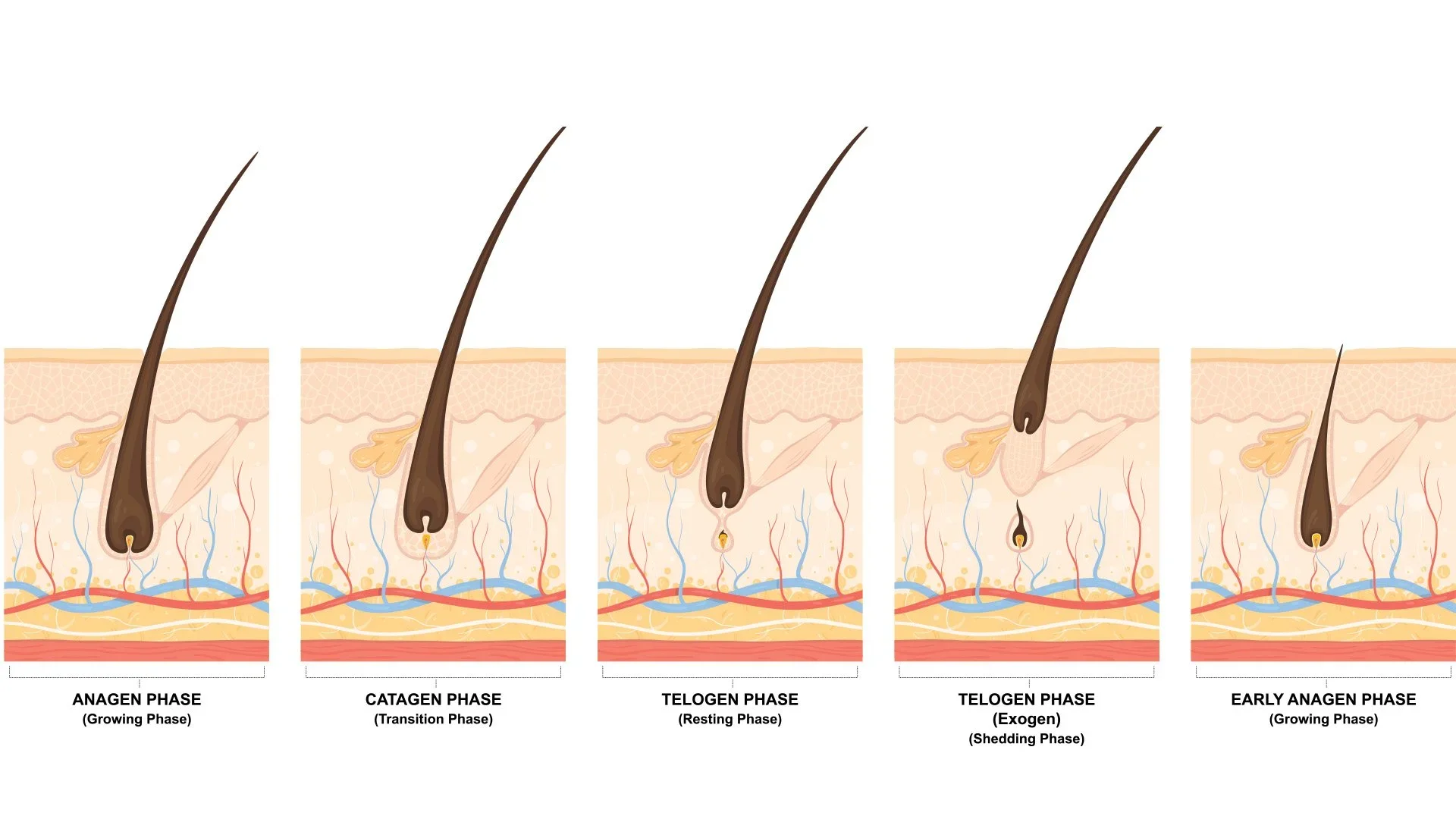
Hair loss conditions occur when internal or external factors artificially shorten the Anagen phase, force too many hairs into the Telogen phase prematurely, or physically destroy the follicle entirely.
Androgenetic Alopecia (Pattern Baldness)
Androgenetic Alopecia, commonly referred to as male or female pattern baldness, is the leading cause of hair loss globally, accounting for over 95% of cases. It is a strictly genetic condition dictated by how your hair follicles interact with a highly potent androgen hormone called Dihydrotestosterone (DHT).
DHT is a natural derivative of testosterone, synthesized by an enzyme in the body called 5-alpha-reductase. If you possess the genetic predisposition for pattern baldness, the hair follicles located at the temples, crown, and frontal hairline are inherently sensitive to DHT.
When DHT binds to the androgen receptors in these susceptible follicles, it triggers a biological process known as miniaturization. The DHT slowly suffocates the follicle, artificially shortening its Anagen (growth) phase while extending its Telogen (resting) phase. Over successive cycles, the hair shaft produced becomes thinner, shorter, and weaker. Eventually, the follicle miniaturizes to the point of permanent dormancy or death, closing over with scar tissue and ceasing to produce hair altogether. [1]
Because Androgenetic Alopecia is driven by internal hormone binding and genetic cellular programming, topical oils and natural remedies are not effective solutions. The only way to slow down pattern baldness is to clinically block the 5-alpha-reductase enzyme or surgically bypass the affected follicles.
Telogen Effluvium
Telogen Effluvium (TE) is a form of non-scarring alopecia characterized by rapid, diffuse shedding. Unlike the slow, progressive miniaturization of pattern baldness, TE is an acute, reactive condition. It occurs when a severe shock to the system forces up to 30% of the scalp's hair follicles abruptly out of the Anagen phase and directly into the Telogen (resting) phase.
Approximately two to three months after the triggering event, this massive volume of resting hair enters the shedding phase simultaneously, leading to significant amounts of hair falling out in response.
Common systemic triggers for Telogen Effluvium include:
Severe physiological stress (e.g., major surgery, high fever, severe infections)
Significant hormonal shifts (e.g., postpartum recovery, stopping oral contraceptives)
Extreme nutritional deficiencies or rapid, restrictive weight loss
Acute psychological trauma
A critical distinction of TE is that the hair follicles themselves are not permanently damaged or miniaturizing. Once the underlying physiological stressor is resolved, the hair cycle will naturally reset, and the hair will typically regrow without advanced medical intervention.
Diffuse Hair Loss
While pattern baldness typically presents as a receding hairline or an expanding bald spot on the crown, Diffuse Hair Loss is characterized by an overall decrease in hair density evenly distributed across the entire scalp.
This can manifest in a few clinical forms, most notably Diffuse Unpatterned Alopecia (DUPA). DUPA is particularly challenging because it does not follow the standard Norwood (for men) or Ludwig (for women) scales of progression. It thins the hair globally, including the "safe donor areas" at the back and sides of the head.
Diffuse thinning is often the result of complex internal imbalances rather than localized DHT sensitivity. It requires extensive medical investigation, as it is frequently linked to underlying thyroid dysfunction (hypothyroidism or hyperthyroidism), severe iron-deficiency anemia, autoimmune disorders, or adverse reactions to systemic medications. Treating diffuse hair loss requires diagnosing and managing the underlying medical condition; attempting to treat it with holistic scalp remedies may only result in continued, widespread thinning.
Chapter 2: Viral Natural Remedies—Fact vs. Fiction
Deconstructing the Most Popular Home Hair Remedies
The internet is saturated with holistic remedies, DIY serums, and viral TikTok trends promising to restore lost hair. Driven by a highly understandable desire for natural, chemical-free solutions, millions of patients turn to these alternatives before seeking professional help.
However, when evaluating these treatments, we must separate cosmetic improvement from clinical hair restoration. Cosmetic improvements make the existing hair look shinier, thicker, or less prone to breakage whereas clinical restoration involves biologically altering the hair follicle to produce a terminal hair where it previously could not.
Can Batana Oil Prevent Hair Loss?
Batana oil, extracted from the nut of the American oil palm tree (Elaeis oleifera) native to Honduras, has surged in popularity as a "miracle" hair growth treatment. Proponents claim it can repair damaged hair and trigger new growth in balding areas.
From a biochemical standpoint, batana oil is incredibly rich in essential fatty acids, specifically oleic and linoleic acid, as well as Vitamin E and phytosterols. When applied to the hair, these large lipid molecules coat the hair shaft, smoothing the lifted cuticles and locking in moisture.
The Reality: Batana oil is a phenomenal cosmetic conditioner. It is highly effective at healing thermally or chemically damaged hair shafts, preventing mid-shaft breakage, and providing an immediate illusion of thicker, healthier hair. However, its molecular weight is far too large to penetrate the scalp's dermis, and it possesses no known ability to inhibit 5-alpha-reductase or block DHT. While it may make the hair you have look fantastic, it will not prevent or reverse genetic hair loss.
Castor Oil and Olive Oil for Hair Growth
Castor oil and olive oil have been utilized in hair care for centuries. Castor oil, in particular, is frequently cited as a growth stimulant due to its high concentration of ricinoleic acid. The theory promoted by holistic practitioners is that ricinoleic acid stimulates prostaglandin E2 (PGE2) receptors in the scalp, which in turn dilates blood vessels and increases circulation to the follicle.
The Reality: While ricinoleic acid does possess mild anti-inflammatory properties, the clinical evidence supporting its ability to significantly increase scalp microcirculation to the point of reversing miniaturization is virtually nonexistent.
Like batana oil, castor and olive oils act primarily as structural sealants and heavy humectants. They coat the hair strand, reducing friction and protecting against environmental damage. This prevents the hair from snapping off prematurely, which can create the perception of faster growth because the hair is successfully retaining its length. However, slathering heavy oils on a scalp actively experiencing pattern baldness can actually be counterproductive as heavy lipids can clog pores, trigger seborrheic dermatitis, and exacerbate scalp inflammation, leading to a poorer environment for healthy follicle function.
Rosemary Oil vs. Minoxidil
Of all the natural remedies, rosemary oil possesses the strongest foothold in clinical conversation, largely due to a highly publicized 2015 study published in the SKINmed Journal. This study compared the efficacy of topical rosemary oil to 2% minoxidil in patients with androgenetic alopecia over a six-month period, concluding that both groups experienced similar increases in hair count. [2]
The Reality: While rosemary oil does contain ursolic acid, which has been shown to mildly improve localized tissue circulation, the 2015 study is frequently taken out of context.
The study compared rosemary oil against a 2% minoxidil solution, which is the weakest commercially available concentration (modern clinical protocols utilize 5% to 8% concentrations for meaningful results).
The overall hair count increases in both groups were incredibly marginal.
The study lacked a placebo control group, making it difficult to ascertain the true baseline efficacy of the oil.
Rosemary oil is the most scientifically sound of the natural topicals and may offer mild, localized circulatory support to the scalp. However, its efficacy is extraordinarily limited when compared to the aggressive vasodilation and growth-phase extension provided by pharmaceutical-grade treatments.
Comparing Natural Remedies
| Remedy | Scientific Backing | Primary Benefit | Can It Regrow Hair? |
|---|---|---|---|
| Batana Oil | Low | Scalp conditioning & shine | No |
| Castor Oil | Low | Reduces hair shaft breakage | No |
| Rosemary Oil | Moderate | Mild microcirculation improvement | Extremely limited |
| Baking Soda | None (Hazardous) | None (Disrupts scalp pH) | No (Can cause damage) |
Chapter 3: Over-the-Counter Serums and Supplements
The Reality of Grocery Store Hair Solutions
When natural oils fail to deliver results, the next step for many patients is the pharmacy aisle. Over-the-counter (OTC) supplements and cosmetic hair serums represent a multi-billion-dollar industry. However, the vast majority of these products rely on aggressive marketing rather than clinical efficacy, exploiting the desperation of patients experiencing early-stage thinning.
Hair Growth Supplements: Biotin and Beyond
If you look at the label of most commercial hair growth gummies or vitamins, the primary active ingredient is Biotin (Vitamin B7). The narrative sold to consumers is that because hair is made of keratin, and biotin plays a role in keratin infrastructure, massive doses of biotin will result in rapid, thick hair growth.
The Clinical Truth: Oral supplementation only works if you are actively deficient in that specific nutrient. True biotin deficiency is exceedingly rare in developed nations, affecting approximately 1 in 137,000 people. [3] If your hair loss is caused by Androgenetic Alopecia (DHT sensitivity), pumping your body full of excess biotin will do absolutely nothing to stop the miniaturization of your follicles. Your body will simply excrete the water-soluble vitamin.
Supplements containing Iron, Zinc, and Vitamin D can be genuinely beneficial, but only if bloodwork confirms you have a systemic deficiency causing Diffuse Thinning or Telogen Effluvium. For genetic pattern baldness, OTC supplements are widely ineffective as a standalone treatment.
Topical Cosmetic Serums
The market is flooded with high-end cosmetic serums containing proprietary peptide blends, botanical extracts, and amino acids. These products often boast clinical-sounding names and promise to "awaken dormant follicles."
The inherent flaw in cosmetic serums lies in the laws of human dermatology, specifically, the 500 Dalton Rule. For a molecule to successfully penetrate the stratum corneum (the outermost barrier of the skin) and reach the deep dermis where the hair bulb resides, its molecular weight must be under 500 Daltons. [4]
The vast majority of the complex peptides and botanical proteins used in OTC cosmetic serums are too large to penetrate the skin barrier. They sit on the surface of the scalp, providing temporary hydration and cosmetic plumping to the base of the hair shaft, but they never reach the biological machinery of the follicle to enact real cellular change. Unless a serum contains a proven, low-molecular-weight pharmaceutical agent specifically formulated in an advanced transdermal carrier vehicle, it cannot reverse hair loss.
Chapter 4: Clinical and Medical Interventions
Medically Proven Protocols for True Hair Restoration
When you transition from holistic guesswork to evidence-based medicine, the approach shifts from cosmetic conditioning to altering cellular biology. Qualified physicians should rely on protocols that are subjected to rigorous clinical trials and FDA scrutiny. True hair restoration requires intervening at the biological level to block DHT, force the follicles back into the Anagen phase, or surgically redistribute immune tissue.
FDA-Approved Medical Treatments
There are currently only two medications formally approved by the FDA for the treatment of genetic pattern baldness. These act as the foundation of any legitimate medical restoration strategy:
Minoxidil: Originally developed as an oral blood pressure medication, topical Minoxidil is a powerful vasodilator. When applied to the scalp, it widens the localized blood vessels, flooding the starving, miniaturized hair follicles with oxygen, blood, and nutrients. More importantly, Minoxidil acts as a potassium channel opener, biologically forcing dormant follicles out of the Telogen (resting) phase and locking them into a prolonged Anagen (growth) phase. While it does not block DHT, it aggressively stimulates the follicle to outpace the miniaturization process. [5]
Finasteride: Finasteride targets the root hormonal cause of pattern baldness. It is an oral, prescription-only medication that acts as a potent 5-alpha-reductase inhibitor. By blocking the enzyme responsible for converting testosterone into DHT, Finasteride can lower systemic DHT levels by up to 70%. This stops the ongoing miniaturization of the follicles in its tracks, allowing the hair to regain thickness.
Non-Surgical Clinical Therapies
For patients seeking to maximize their preventative care, or those who cannot tolerate pharmaceutical interventions, modern clinics offer advanced, non-surgical therapies that may exceed the capabilities of OTC serums:
Custom Compounded Topicals: Rather than relying on standard over-the-counter minoxidil, specialized clinical teams can formulate prescription-grade topical compounds. These often combine high-concentration Minoxidil with topical Finasteride, Retinoic Acid (to increase skin permeability), and anti-inflammatory corticosteroids. This delivers the DHT-blocking power of Finasteride directly to the scalp without the systemic side effects associated with the oral pill.
Low-Level Laser Therapy (LLLT): Utilizing clinical-grade laser caps like the FDA-cleared CapillusRX (link), LLLT employs photobiomodulation. Specific wavelengths of red light penetrate the scalp tissue, stimulating the mitochondria within the follicular cells. This increases the production of Adenosine Triphosphate (ATP), or cellular energy, which reduces inflammation, extends the Anagen phase, and encourages thicker hair shafts.
Cellular and Autologous Therapies: Treatments like Platelet-Rich Plasma (PRP) utilize the patient's own blood. By centrifuging the blood to isolate platelets and injecting them directly into the thinning scalp, large concentrations of growth factors (such as PDGF and VEGF) can be delivered to the follicles. These treatments may accelerate tissue repair, promote new blood vessel formation (angiogenesis), and stimulate follicular activity but are not FDA-approved and are supported by less research.
Permanent Restoration: FUE and FUT Surgery
Medical management, pills, topicals, and lasers, shares one absolute biological limitation: they only work on living hair follicles.
Once DHT has fully miniaturized a follicle to the point of irreversible dormancy or death, and the tissue has scarred over, no medication on earth can bring it back to life. If you have areas of slick, completely bald skin, such as a receded hairline or a fully exposed crown, medical management will only maintain the hair you have left.
To restore hair to areas where it has permanently ceased growing, surgical intervention is the only viable solution. Modern hair transplantation relies on the biological concept of "Donor Dominance." The hair follicles located in the "safe donor zone" at the back and sides of the head are genetically immune to the effects of DHT.
Specialized restoration surgeons utilize state-of-the-art techniques to relocate these immune follicles:
Follicular Unit Extraction (FUE): Individual follicular units are extracted one by one using microscopic punches (often less than 1mm in diameter) and meticulously implanted into the balding areas, leaving no linear scar.
Follicular Unit Transplantation (FUT): A thin strip of tissue is removed from the donor area, dissected into individual grafts under high-powered microscopes, and implanted.
Because these transplanted follicles retain their genetic resistance to DHT, they will continue to grow in their new location permanently. When executed by an expert medical team, a hair transplant delivers an entirely natural, undetectable, and permanent restoration of your lost density.
Chapter 5: Designing a Long-Term Strategy
Moving Beyond Home Remedies
The most dangerous side effect of experimenting with holistic oils and OTC supplements is not physical harm, but the loss of time. Hair loss is a progressive, ticking clock. Every month spent massaging castor oil into a receding hairline is a month that DHT is allowed to continue its destruction of your follicles. Waiting too long to seek medical intervention can reduce your available hair and limit your options.
The Diagnostic Checklist
How do you know when it is time to abandon the natural remedies and seek clinical evaluation? If you answer "yes" to any of the following, immediate medical intervention is required:
Patterned Recession: Is your hairline distinctly moving backward at the temples, or is a circular bald spot expanding at the crown?
Visible Scalp: When your hair is wet or styled normally, can you clearly see your scalp in areas where you previously could not?
Miniaturization: Are the hairs falling out significantly thinner, shorter, and more translucent than the hairs on the sides of your head?
Duration: Have you been experiencing increased shedding or noticeable thinning for more than six consecutive months without spontaneous recovery?
Family History: Do you have a history of pattern baldness on either your mother's or father's side of the family?
The Value of Professional Hair Loss Consultation
Attempting to diagnose your own hair loss through internet research is a recipe for failure. True restoration begins with a comprehensive, clinical evaluation by dedicated medical professionals.

At Advanced Hair Restoration, our teams utilize high-magnification trichoscopy to analyze your scalp at the microscopic level. [6] This allows us to assess the precise degree of follicular miniaturization, map the borders of your DHT sensitivity, evaluate the health of your donor supply, and rule out underlying dermatological conditions like inflammation or scarring alopecia.
Based on this hard clinical data, we design a personalized treatment plan. A successful long-term strategy often combines surgical restoration to rebuild the hairline with ongoing medical management (like Finasteride and Minoxidil) to protect the existing native hair from future loss.
Stop gambling your hair's future on unproven holistic trends. By transitioning to evidence-based medicine, you take definitive, permanent control over your restoration journey.
Frequently Asked Questions
Does pumpkin seed oil block DHT naturally?
Some preliminary studies suggest pumpkin seed oil may weakly inhibit 5-alpha reductase, the enzyme responsible for converting testosterone to DHT. However, its efficacy is extraordinarily minor compared to medical-grade treatments. While it can serve as a supportive holistic supplement, pumpkin seed oil is not powerful enough to halt aggressive, genetic pattern baldness on its own.
Does baking soda regrow hair?
No. Baking soda is highly alkaline and can strip the scalp's natural acid mantle, leading to severe dryness, irritation, and increased hair breakage. Applying baking soda to the scalp disrupts the natural microbiome and provides zero biological stimulation to the hair follicles. It can actively worsen the health of your existing hair.
Can you reverse thinning hair entirely with lifestyle changes?
Only if the hair loss is caused by a temporary lifestyle factor, such as poor nutrition, extreme acute stress, or rapid weight loss (a condition known as Telogen Effluvium). If the thinning is genetic (Androgenetic Alopecia), lifestyle changes like diet, exercise, and stress reduction will not stop the hormone DHT from miniaturizing your follicles. Genetic hair loss requires medical or surgical intervention to reverse.
Clinical References
Natarelli, N., Gahoonia, N., & Sivamani, R. K. (2023). Integrative and Mechanistic Approach to the Hair Growth Cycle and Hair Loss. Journal of Clinical Medicine, 12(3), 893. URL:https://www.ncbi.nlm.nih.gov/pmc/articles/PMC9917549/
Panahi, Y., Taghizadeh, M., Marzony, E. T., & Sahebkar, A. (2015). Rosemary oil vs minoxidil 2% for the treatment of androgenetic alopecia: a randomized comparative trial. SKINmed, 13(1), 15-21. URL:https://pubmed.ncbi.nlm.nih.gov/25842469/
Bistas, K. G., & Tadi, P. (2023). Biotin. In StatPearls. StatPearls Publishing. URL:https://www.ncbi.nlm.nih.gov/books/NBK554493/
Bos, J. D., & Meinardi, M. M. (2000). The 500 Dalton rule for the skin penetration of chemical compounds and drugs and the clinical significance for topical drugs. Experimental Dermatology, 9(3), 165-169. URL:https://pubmed.ncbi.nlm.nih.gov/10839713/
Suchonwanit, P., Thammarucha, S., & Leerunyakul, K. (2019). Minoxidil and its use in hair disorders: a review. Drug Design, Development and Therapy, 13, 2777–2786. URL:https://www.ncbi.nlm.nih.gov/pmc/articles/PMC6691938/
Jain, N., Doshi, B., & Khopkar, U. (2013). Trichoscopy in alopecias: diagnosis simplified. International Journal of Trichology, 5(4), 170–178. URL:https://www.ncbi.nlm.nih.gov/pmc/articles/PMC3999645/